Early History & Sources Beyond Europe
Early visual and written sources allow only cautious conclusions about the origins and form of the bow.
|
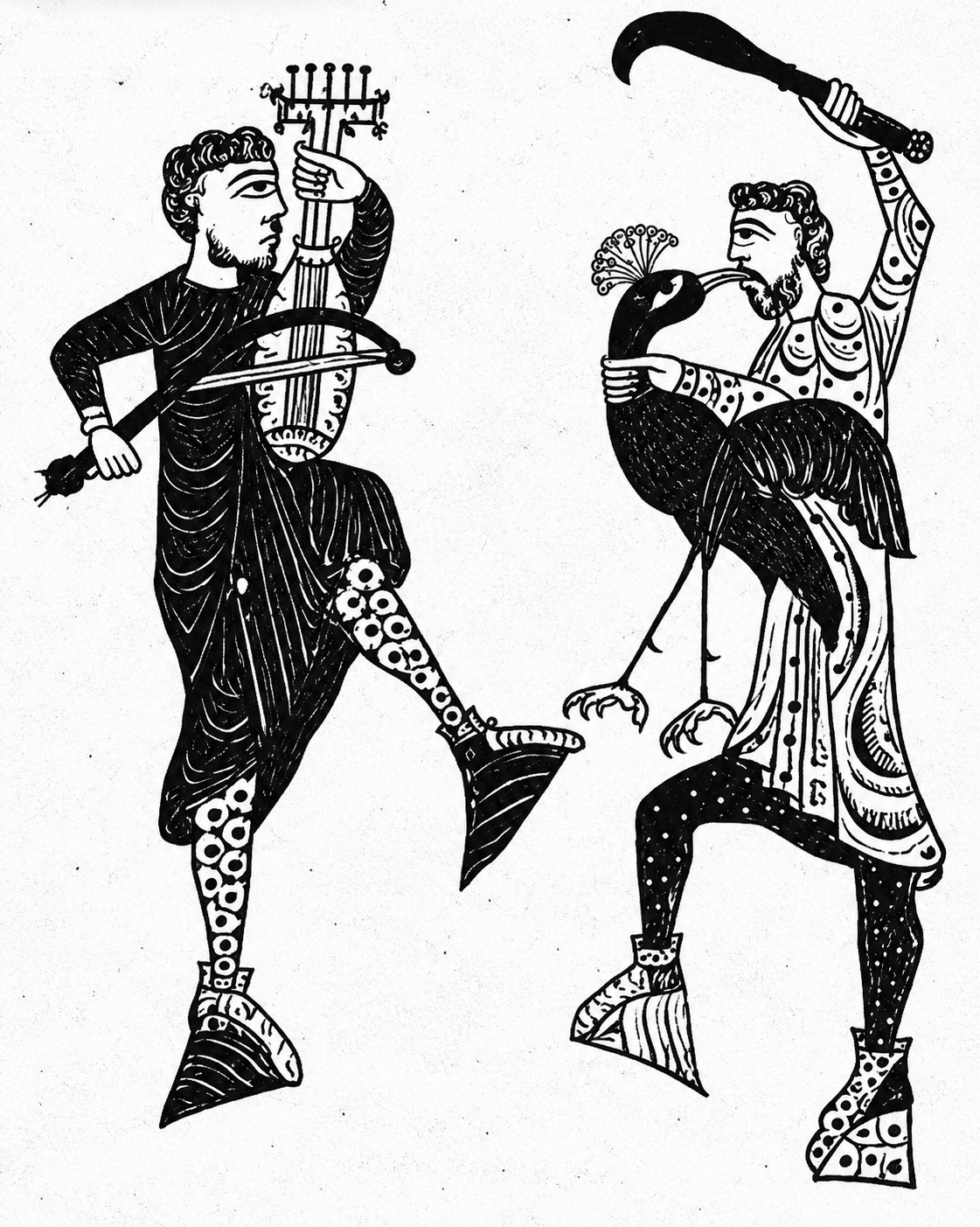
Specialist literature generally treats the early history of the bow only briefly and sometimes contradictorily. There are many reasons for this. Original examples, for instance, could have survived to the present only under exceptional physical conditions. Iconographic depictions and written accounts are therefore the only sources available, at least for the earliest period. Religious restrictions—the Old Testament prohibited depictions of people or objects—further complicate matters. Yet drawing conclusions from images about bows’ stage of development, craftsmanship, or even playing characteristics is extremely difficult. Some depicted bows look crude; others seem well balanced and elegant. The artist’s skill and knowledge of detail must be taken into account when assessing their accuracy. For example, it is scarcely possible to compare directly the precision of this miniature from 1109 |
|
with that of Gerard van Honthorst’s 1613 painting “Man Playing the Violin by Candlelight.” Caution is needed when analyzing proportions, perspective, and construction details such as the attachment of the hair or the curve of the stick. Early depictions in particular rarely allow a bow’s length to be measured or calculated accurately. Written sources, in turn, are vulnerable to errors in translation. Since few other sources are available, however, we must approach these with the necessary care. |
|
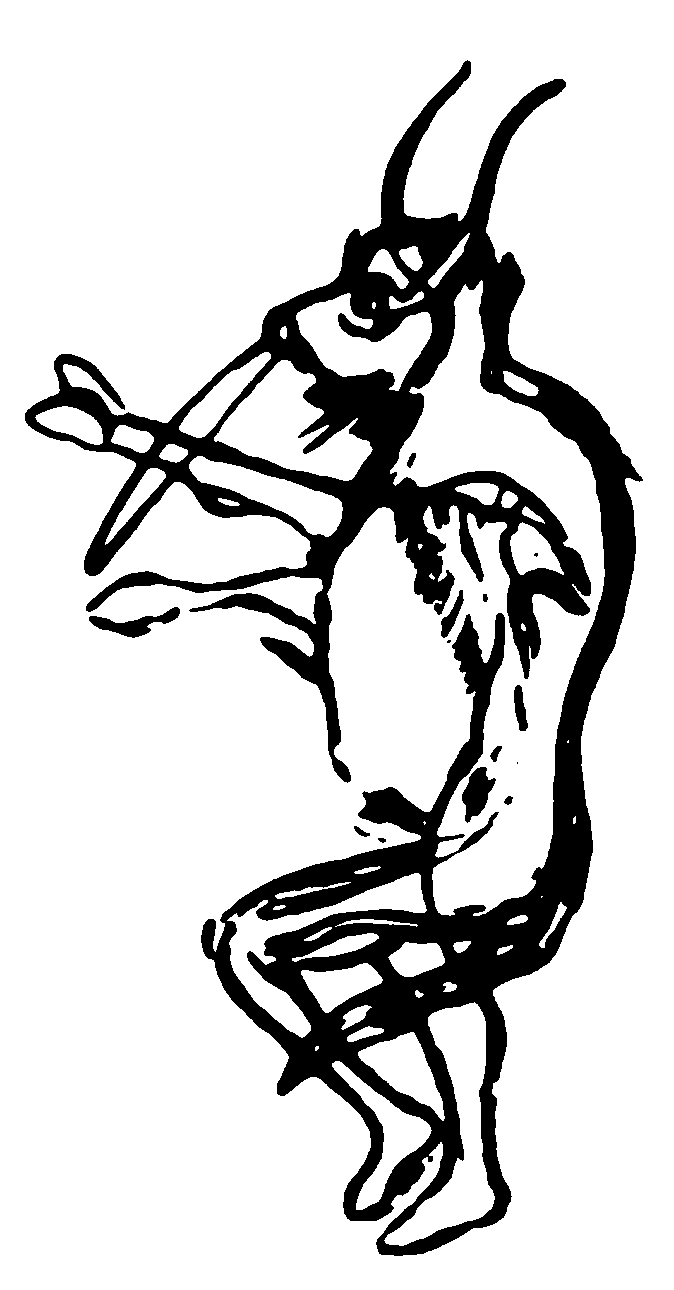
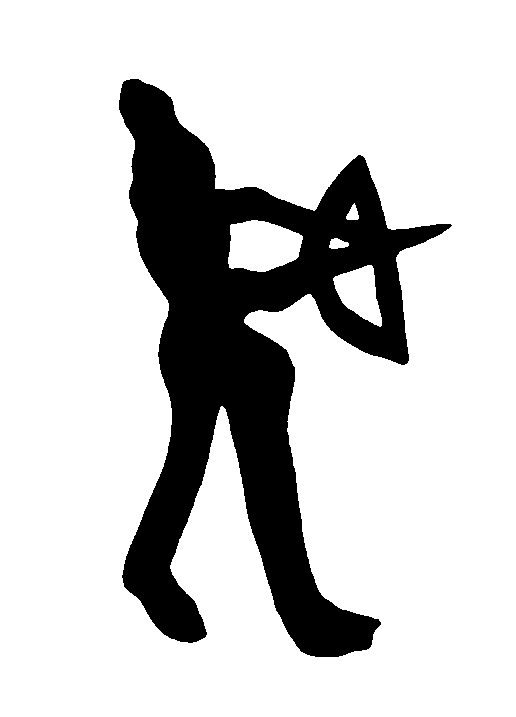
What may be the earliest evidence of a musical bow appears in a Paleolithic cave painting dating from about 15,000–10,000 BCE. These paintings in the Trois Frères caves in southern France depict dancing, masked sorcerers dressed in animal skins. One figure, disguised as a bison, holds a bow-like object whose meaning remains disputed among specialists. Since the only instruments known from Paleolithic finds so far are pipes, experts are uncertain whether the object represents an end-blown flute or a musical bow. This does not rule out the use of musical bows whose materials simply decayed and did not survive. Hunting bows are known to have been used in different parts of the world during this period. In his handbook of musical instruments, Alexander Buchner takes the argument further, suggesting that “the prehistoric hunter noticed the sounds produced by the bowstring when a shot was released” and probably began “to pluck it without intending to shoot, which may have given him pleasure. In time, he realized that bows of different lengths and tensions produced notes of different pitches. When he held the end of the bow in his mouth, tightened the bowstring, and plucked it to judge from its pitch the force with which it would launch an arrow, he must have noticed that the mouth cavity amplified the sound of the string. In this way, he probably discovered, unknowingly, both a resonator and a musical instrument. The magician depicted in the Trois Frères cave holds the upper end of the bow in his mouth, presses its lower end toward himself with his left hand, and plucks the bowstring with his right.” The quality of the cave drawing makes this theory somewhat difficult to follow. Identifying a right or left hand performing the actions described would be highly speculative. The figure could equally well be a hunter with a bow and arrow. |
|
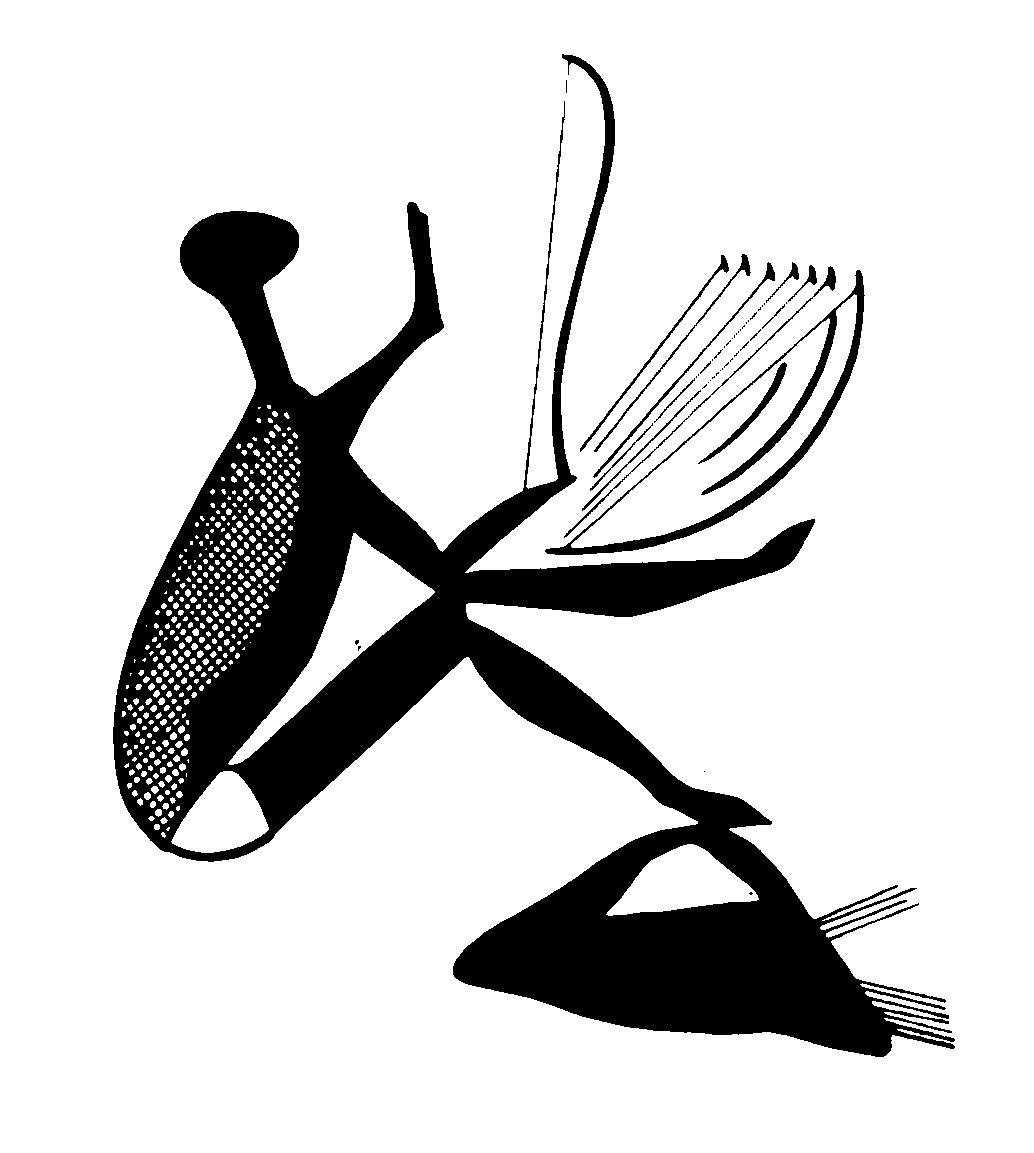
Buchner also considers a cave painting in northwestern Bulgaria relevant to the early history of the bow. “This cave painting depicts a musical bow played with a bow. It forms part of the rock paintings in the Rabish Cave near the town of Belogradchik, and the composition has two levels. The upper level shows a group of dancing women and naked men, evidently painted with dark, ocher-colored kaolin applied by finger. The cave’s damp microclimate eroded and destroyed the rock surface, but the pigment acted as a protective insulating layer and resisted erosion. The pictures thus became a sculptural relief—nature itself preserved the original painting and demonstrated its authenticity. The central figures in the lower part of the painting are two musicians. One holds a bow upright in his left hand, facing toward him, and appears to sound its string with a bow or rubbing stick in his right. The second figure, not shown here, carries a double-headed drum on his chest and strikes it with both hands. Although this find has not yet been studied in detail or dated, its enormous significance for the study of musical instruments already merits consideration.” If closer examination confirms the painting’s authenticity and supports the interpretation of the object as a bow, this would be one of the earliest depictions of a bow, even though the rock painting has not yet been dated precisely. It could, however, also be an accidentally reversed depiction of a hunting bow and arrow. Further interpretation based on the sketch reproduced by Buchner would be too speculative. |
|
Buchner sees evidence of the musical bow’s presence in southern Africa in a rock painting in Cape Town, South Africa. A San man holds a bow in his right hand whose curvature differs from that of the other seven bows shown. A quiver of arrows lies at his feet. The figure could indeed be engaged in a musical activity. But can this be established as conclusively as Buchner suggests? Does he go too far when he writes, “A Bushman holds the bow in his right hand and touches the strings of seven other bows with it,” and concludes that this represents a more advanced stage “in which seven bows form a single instrument, while the bow in the musician’s right hand has already taken on the function of the modern bow”?
|
|
This wall painting from the 9th or 10th century clearly shows a person playing a bowed instrument. It was discovered during excavations of a palace in Tajikistan. Since the palace was destroyed in the 11th century and the painting was whitewashed over at the end of the 10th, the image must date from the 10th century at the latest. |
|
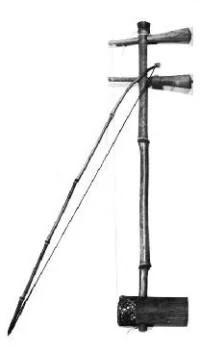
Two bowed instruments are known from 9th-century China: the xiqin, a two-stringed lute played with a bamboo bow between the strings, and the yazheng, a seven-stringed bowed zither rubbed between the strings with a bamboo bow. The xiqin may have resembled the erhu, the Chinese fiddle still in use today. All these bows were strung with horsehair or a string-like material. In this early period of bowed instruments, bow shapes and lengths varied greatly and were not yet standardized. It is striking, however, that many early bows had a strongly convex curve, making them resemble the weapon of the same name. |
The Bow in Medieval Europe
As the European evidence grows, visual sources become more plentiful and bow forms easier to compare.
|
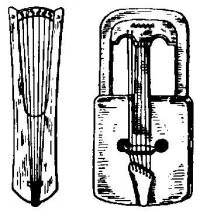
The bowed rote used in France from the 11th to the 13th century had its counterpart in the Welsh crwth. The crwth is mentioned as a plucked instrument as early as 609. It was found as far afield as Brittany, and evidence of its being played with a bow dates from the 10th century. |
|
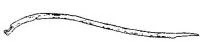
Excavations at Christchurch Place in Dublin uncovered a fragment of an 11th-century bow. From the break, the stick “runs in a slight curve and bends distinctly toward the tip, where it has a notch. The horsehair was evidently wrapped around the stick and tied at the notched point.” If the dating is correct, bowed instruments had spread as far as Ireland by this time. |
|
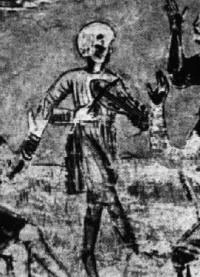
The use of the bow in Italy is also documented in the 11th century. “Among the earliest Italian sources is a fresco dating from around 1011 in the crypt of S. Urbano alla Caffarello near Rome. It depicts the announcement of the Christmas message to the shepherds in the fields […]. One shepherd, apparently dancing, plays a fiddle braced against his chest.” The bow shown is very short and also has a separate handle end, making the playable hair even shorter. |
|
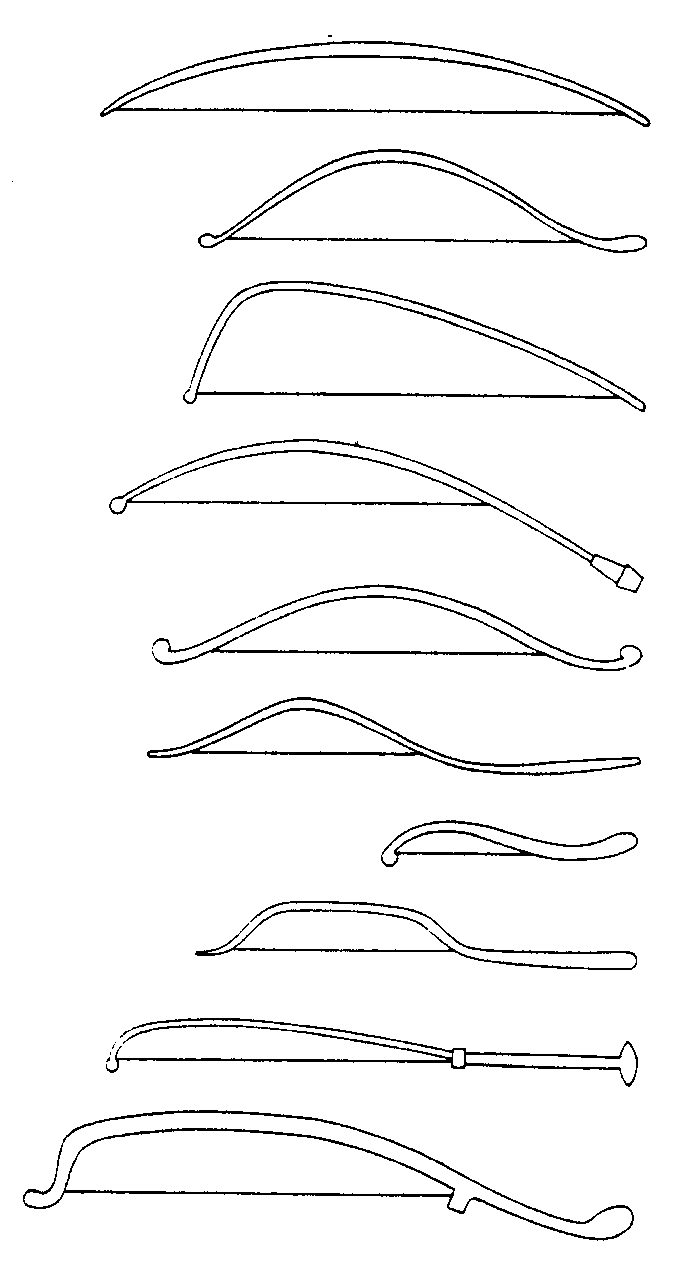
Many different types of bow were tried in the 10th and 11th centuries and, where they proved unsuitable, were abandoned or modified. “This searching and experimenting with a practical form suggests that the bow was still at an early stage of development and had no established models to draw upon.” Several bow forms continued to coexist into the 16th century. As noted above, iconographic research shows that around the year 1000, bows appeared in very different and often extreme forms. These included large, strongly curved, almost semicircular bows held near the middle of the stick, as well as flat, barely curved bows whose hair lay almost against the wood. |
From the 16th to the 17th Century
Instruments, playing styles, and bow forms become more differentiated, and development accelerates.
|
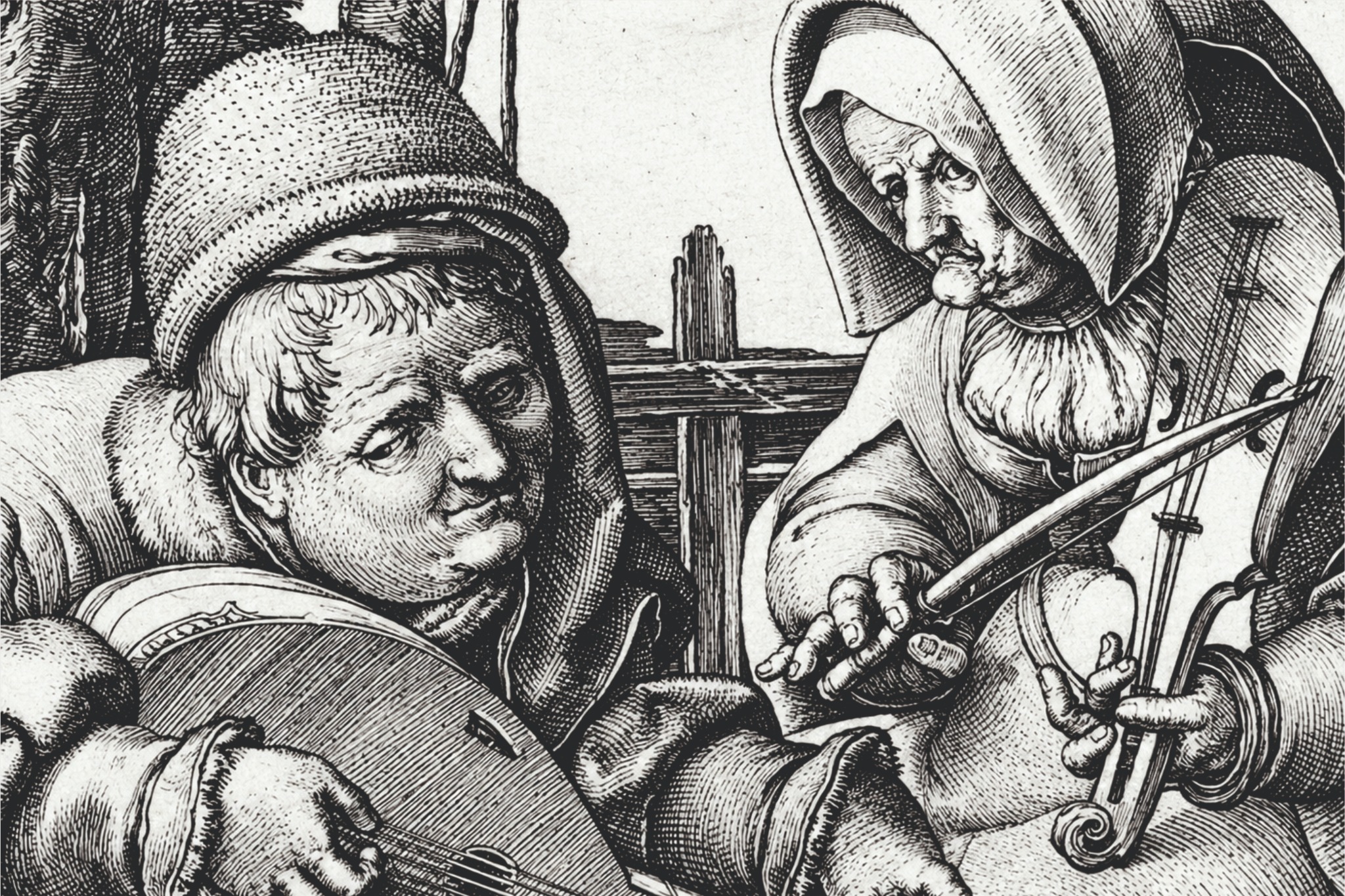
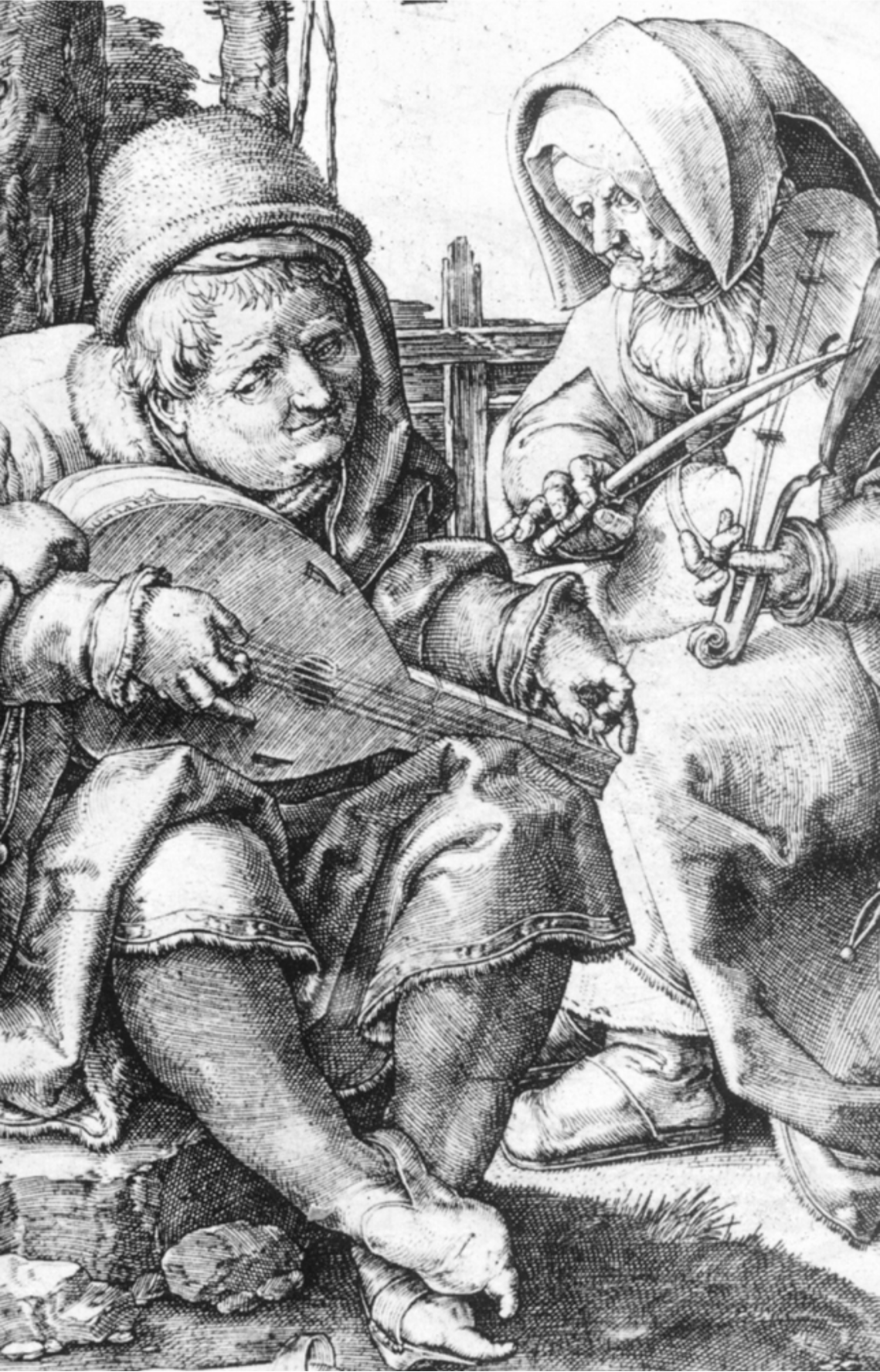
In Lucas van Leyden’s 1524 depiction “Beggar Woman Playing the Fiddle,” the hair is tied to a curved stick made from a native wood. No head is shown in this drawing. Instead, the hair is tied into a loop and hooked into a notch above a thickening at the tip of the stick. No frog is visible, but closer inspection shows that the hair is attached directly to the stick by a loop just above the index finger. The stick is slightly convex to keep the hair away from it during playing. |
|
Alongside the evenly curved round bow, there were bows curved at only one end, with a straight stick that bent sharply near the tip. Another form had a stick extending well beyond the hair at one end. In early examples, this handle was about as long as the haired portion used for playing. The playable hair was therefore very short, allowing only very short strokes.
|
|
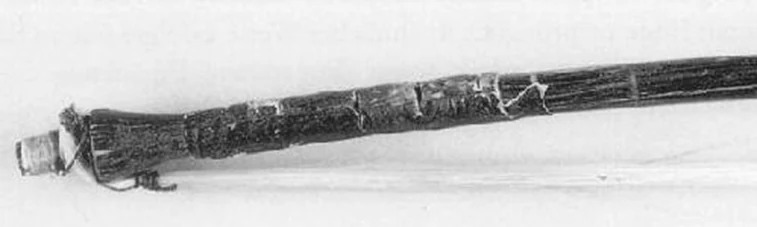
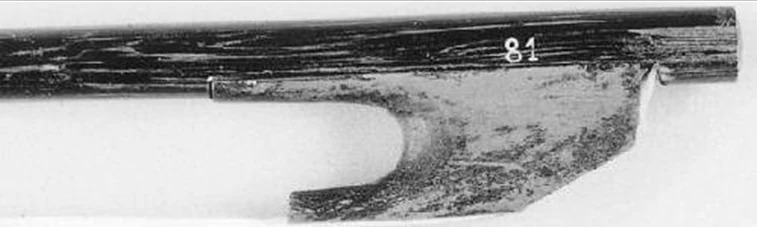
This Italian bow from the 16th century clearly shows the hair attached directly to the stick. The lower end of the stick may have been shortened, and the clip-in frog may be a later addition. Unlike the violin, whose qualities could usually be adapted to changing tastes through alterations, the bow was set aside once it went out of fashion. Perhaps it became firewood or a tomato stake in a vegetable patch. Making a new bow was easier than rebuilding an old one to meet new requirements. Surviving traveling musicians’ bows from this and later periods, used mainly for dance music, were made from native woods such as larch, willow, or beech—or, in this example, palm wood. By modern standards, these woods are much too soft and light because of their very low density. |
|
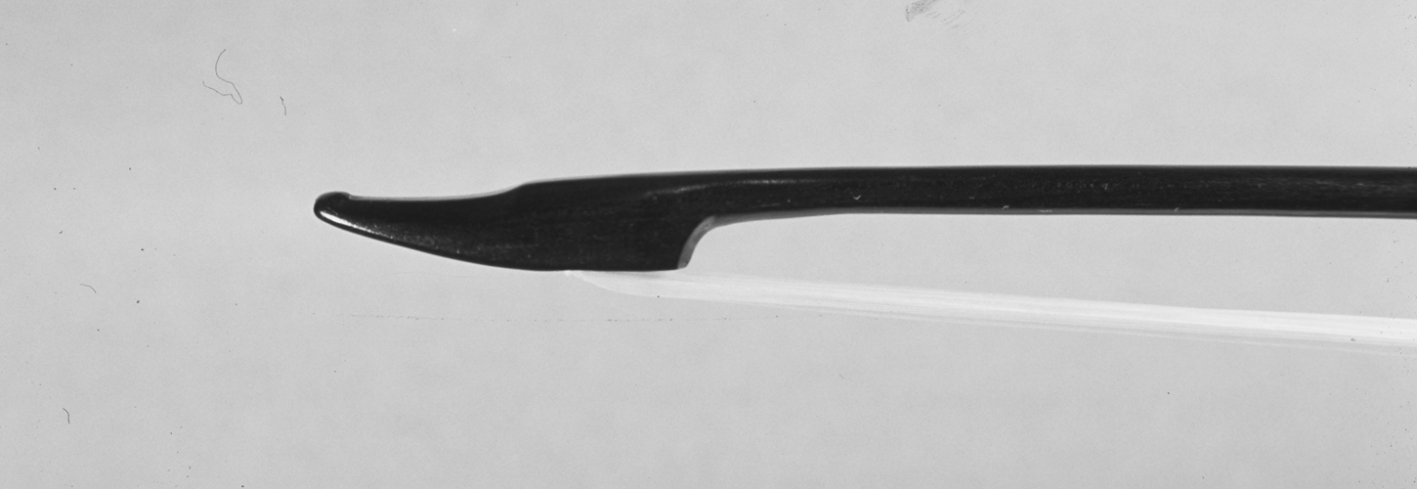
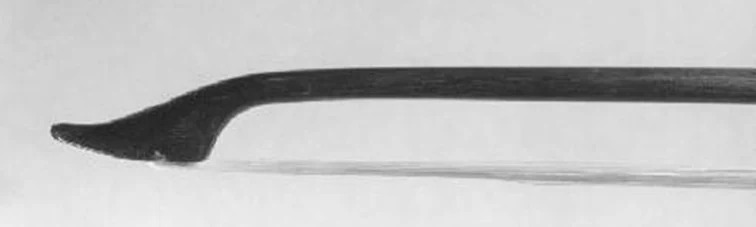
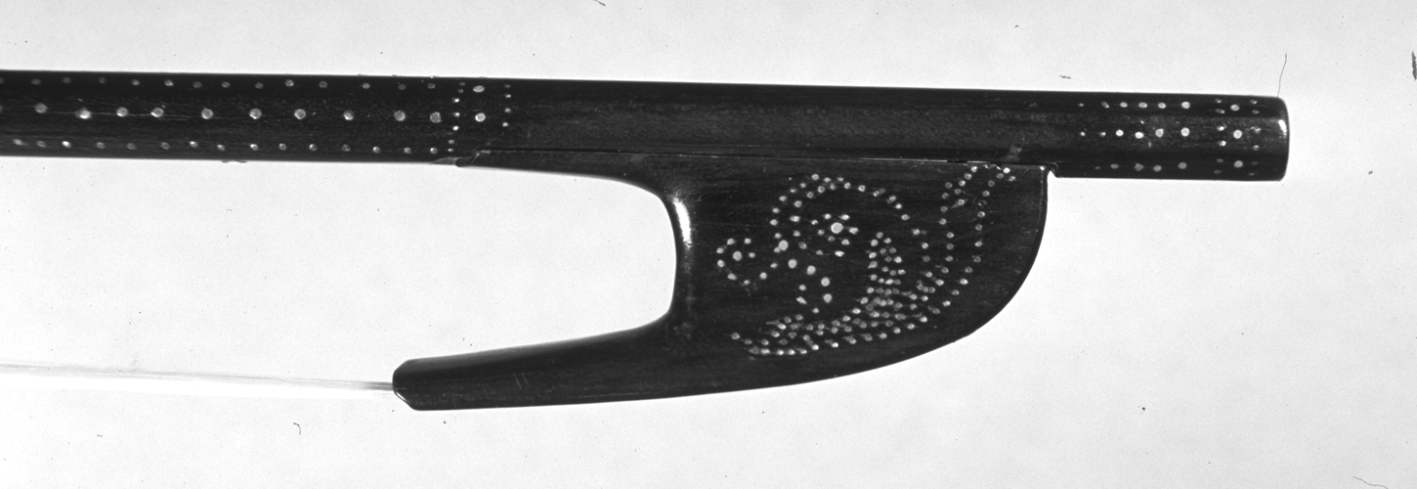
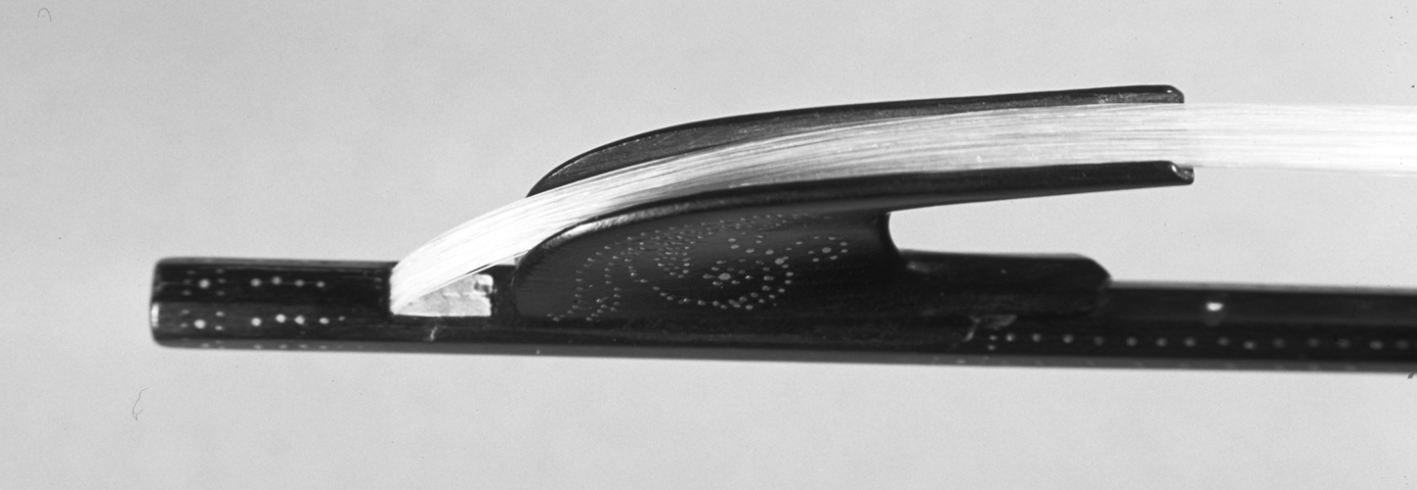
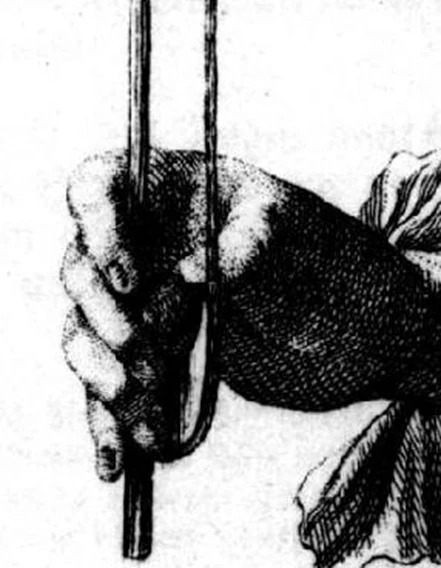
Around 1650, a pike-shaped head developed, allowing the hair to be secured with a plug and held away from the stick at the tip. In the early 17th century, the stick was still slightly convex or nearly straight. At its lower end, a removable wedge kept the hair away from the stick. This inserted frog gives the type its name: the clip-in-frog bow. Its hair tension could not yet be adjusted with a mechanism. The bow could be tensioned or released, but not finely adjusted. Since horsehair changes length with humidity and temperature, the tension presumably varied. With the underhand hold used for the viol, the middle and ring fingers can pull the hair away from the stick. With the overhand violin-bow hold, comparable manual tensioning is possible only to a limited extent with the thumb. It is now thought that players were already looking for ways to vary violin-bow hair tension, inserting small wedges or pieces of gut string between hair and frog when the hair became too slack. After playing, the frog was removed to allow the hair to recover. |
|
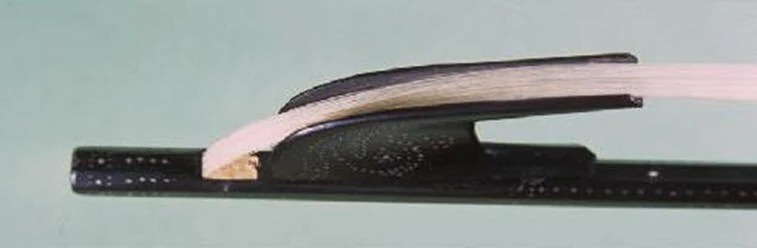
The clip-in mechanism is particularly clear on a viola d’amore bow in the Germanisches Nationalmuseum in Nuremberg. It belongs to a viola d’amore made by Caspar Stadler in Munich in 1714. Unfortunately, it is not known whether the bow was also made by him. This finely crafted work is made from a very dark tropical wood. Silver pins richly decorate both the end of the stick and the frog. |
|
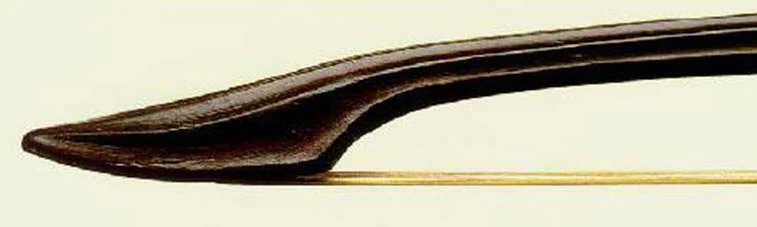
Here, the hair is clearly anchored in the stick rather than in the frog, as is customary today. You may have wondered how the frog got its name. There are several theories. It may refer to its shape, which on some older bows resembles a sitting frog. Looking at the word’s etymology, one finds the form froska, meaning “to hop”—did the wedge spring away like a hopping frog when the musician removed it? Or might the name be related to the French hausse, meaning something like a wedge or support and widely used in French crafts? A sound shift (…) could have turned this into the German Frosch. Then as now, the frog’s function was to keep the hair away from the stick at the lower end of the bow. |
|
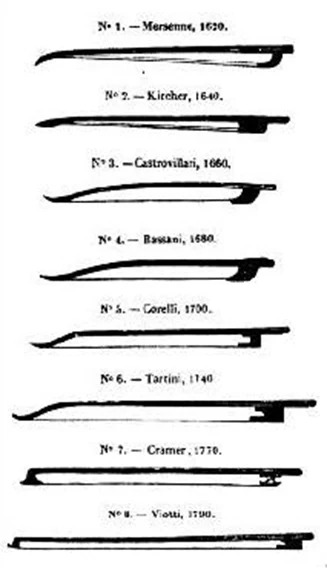
Some surviving 17th-century bows look crude. They were probably used by itinerant musicians and, as noted above, were usually made from native woods. Others, however, were carefully and artfully made. Their round or octagonal sticks were sometimes fluted in the upper half. Material was removed in grooves so that the stick resembled a Greek column in cross section. This served both aesthetic and playing purposes. The bow’s balance point moved toward the frog, and the upper part became lighter without losing a corresponding amount of tensioning strength. |
|
The finest players must have used such bows. They are well made and exceptionally capable of meeting the musical demands of their time. We also know this type as the Corelli or Tartini bow. It is reasonable to assume that these two musicians, who contributed so much to violin music, owned bows of this kind. Unfortunately, there is no precise evidence that they were directly involved in their development. Both are reported to have used longer bows than their predecessors, and Tartini is also said to have introduced fluting. There is no firm evidence for these claims, however. The violinists and composers Arcangelo Corelli (1653–1713) and Giuseppe Tartini (1692–1770) also became famous for their violin sonatas. The bow type used in their day is therefore now known as the Italian sonata bow. The finest available materials were chosen for these high-quality tools. Snakewood was popular, but other extremely hard, mostly tropical woods were also used, including massaranduba, ironwood, ebony, and logwood. Inventories show that a bow made from “Indian wood”—meaning an overseas wood—cost several times as much as a simple bow made from “ordinary” wood. |
The 18th Century
New musical demands bring fundamental changes in shape, length, weight, and construction.
|
As late as 1750, clip-in-frog bows predominated in German-speaking regions. The illustrations in Leopold Mozart’s 1756 Versuch einer gründlichen Violinschule show only bows with this mechanism. Depictions from around 1650 onward occasionally show knobs of wood, horn, or ivory at the end of the stick. These may have been decorative, counterweights for adjusting the balance, or screw buttons. Yet the literature nowhere mentions a device for tightening or loosening the hair. Had such a mechanism existed, it would have been a curious coincidence and oversight for Mersenne and Praetorius, the two most comprehensive writers on the instruments of the period, to have said nothing about it. These turned pieces therefore served as counterweights for bows that were sometimes very long. Today, the first screw-frog bows are thought to date from around 1720–1730. |
|
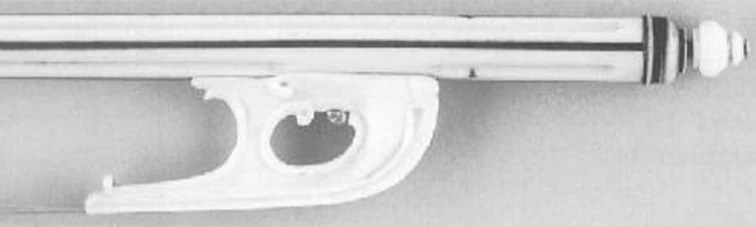
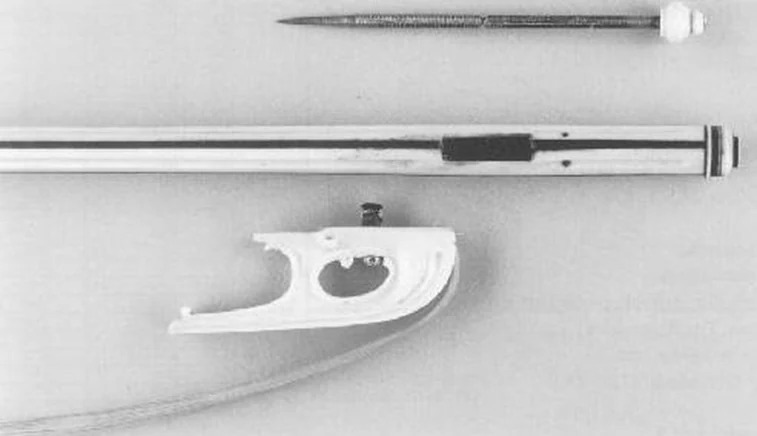
The Kunsthistorisches Museum in Vienna houses a violin made entirely of tortoiseshell and ivory. Made in Prague by a cabinetmaker named Wenzel Kowansky and presented to Empress Maria Theresa in 1749, it has a matching bow of tortoiseshell and ivory. The bow is exceptionally beautiful and remarkable in its craftsmanship. This combination of materials, however, makes it wholly unsuitable for use as a bow. It can therefore be assumed that it was rarely, if ever, played and consequently remains in its original condition. It is probably the earliest datable violin bow with a screw-frog mechanism that has not been altered. |
|
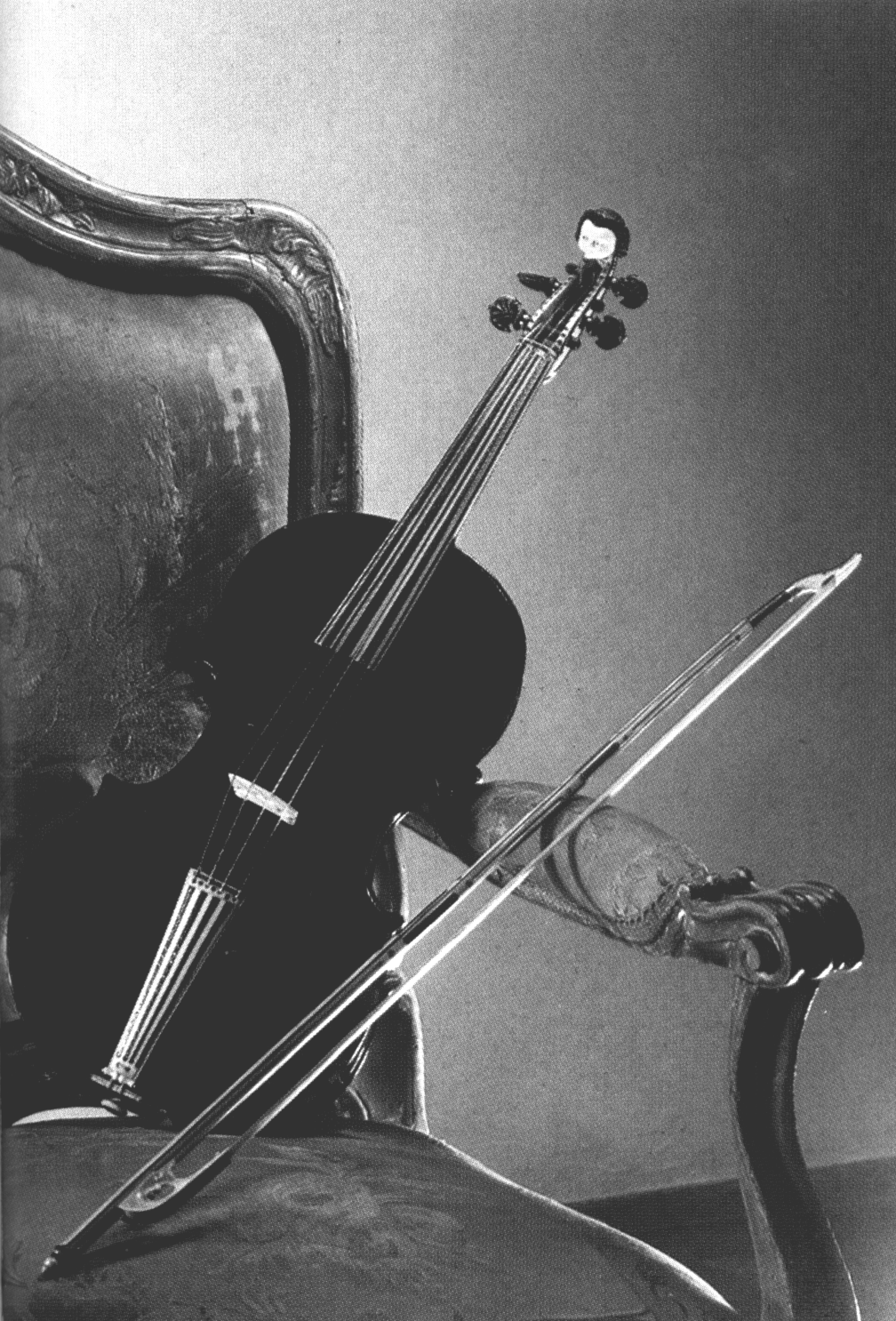
On this bow, the hair is attached to the frog, passes around it, and is held by a plug at the top of the frog’s rear face. |
The Development of the Modern Bow
Developments in the late 18th and early 19th centuries lead to the modern bow.
|
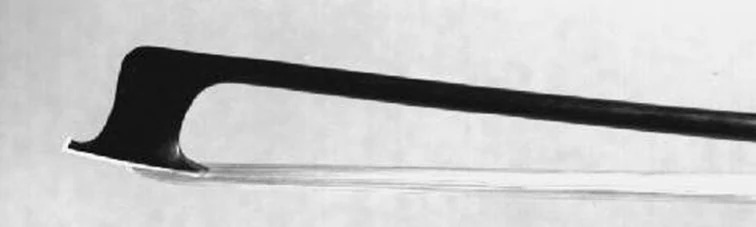
The period from 1770 to 1800 was marked by major political changes that culminated in the French Revolution of 1789. These changes also profoundly affected musical life. Previously, art music had been performed almost exclusively at aristocratic courts or in churches, with musicians dependent on their patrons and audiences limited to a small circle. Concerts now took place in civic concert societies. As middle-class audiences grew, so did the rooms in which music was performed. These new, large concert halls needed to be filled with sound. “Beginning in Paris, violin makers such as Pique and Lupot altered neck angles, neck lengths, bridges, and bass bars on both new instruments and outstanding older ones to meet the new demands. The bow also continued to develop. Overall, the stick became somewhat longer again; taller, stronger, and therefore heavier frogs were tried, and the head also grew taller and more substantial. A larger number of hairs made the bundle somewhat wider. The so-called Cramer bow emerged, often described then and now as a transitional model. Its large, heavy head shifted the balance point toward the middle of the bow. By modern standards, Cramer-model bows are very tip-heavy. The tall head, however, provides a large gap between hair and stick, allowing a deeper concave camber. The hair can now be tensioned more firmly. Bows of this type appear throughout Europe between 1770 and 1800, with the earliest documented examples in France.” The type was most popular between 1772 and 1792, and many bow makers responded to the strong demand. In France, these included Tourte L., Lafleur, and members of the Meauchand family. In England, they included Edward and John Dodd and makers working for Forster or Norris & Barnes. The type was also very popular in Germany. The photograph shows an elegant, fully developed example made between 1780 and 1790 and stamped MEAUCHAND. |
|
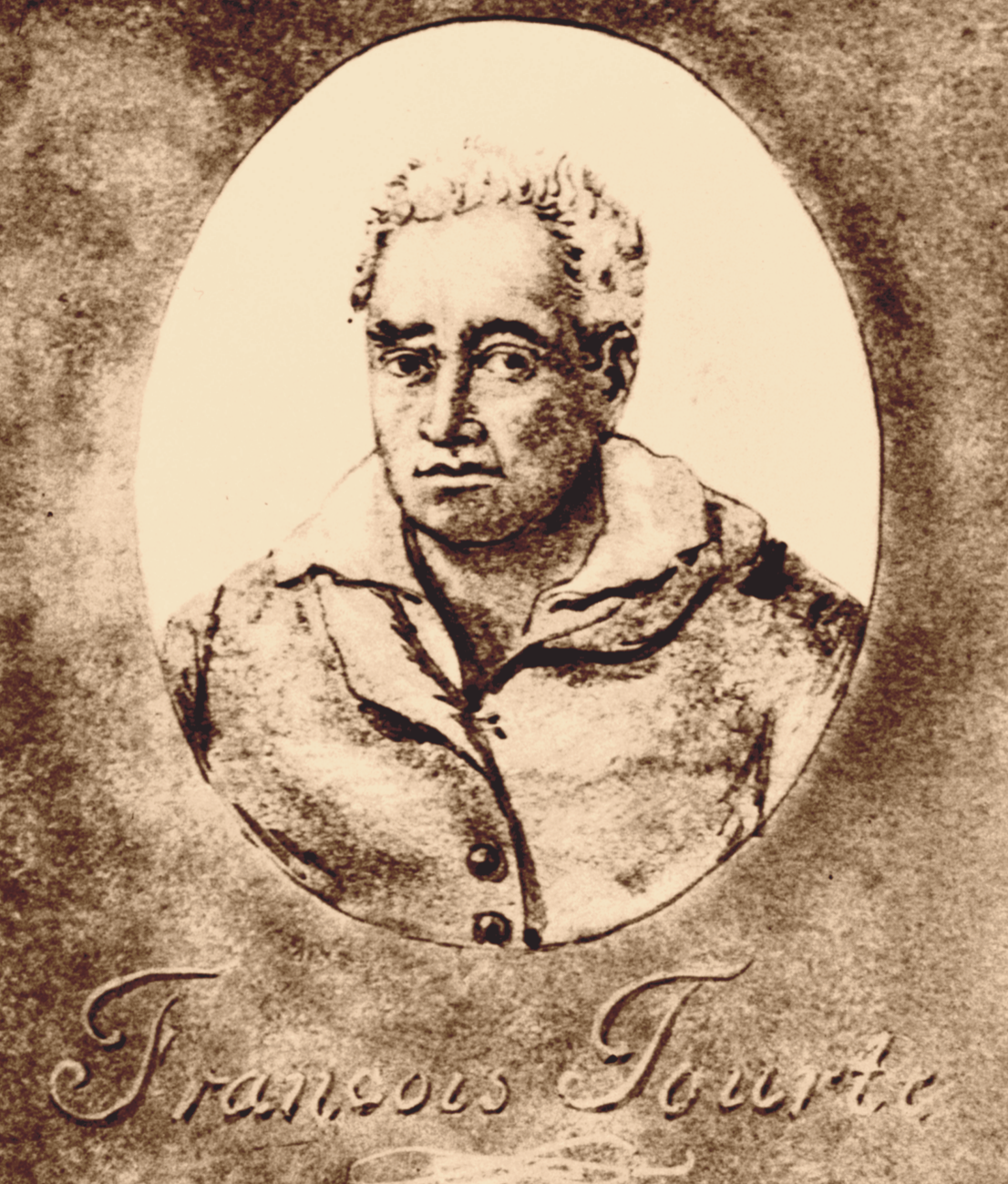
The Cramer model’s problems, including its tip-heavy balance, led to further changes in the violin bow. Fétis calls this new stage the Viotti bow. This prominent Italian musician lived in Paris for several years from 1781/82. Although there is no written evidence, it can be assumed that he had contact with the workshop of the city’s leading bow-making family, the Tourtes. Suggestions for improving the violin bow were evidently taken seriously, as the great variety of bows from the workshop demonstrates. Bows stamped Tourte L. in particular document the continuous development toward the modern bow over a generation. Alongside other experiments, the main changes were reducing the head’s weight by removing its rear portion and stabilizing the hair at the frog with a metal ferrule and spreader wedge. Metal fittings on the frog and button added weight at the grip, resolving the problem of tip-heavy balance. Deeper camber gave the bow greater tension. Neither the birth nor death dates of the maker who stamped his bows “Tourte L.” are known. We know a little more about François Xavier Tourte, who lived from 1747 to 1835. He first trained as a clockmaker and worked in the Tourte workshop from around 1770. His clockmaking training had familiarized him with metalwork. He was most likely the person who introduced metalwork into bow making and brought it to an unsurpassed level of mastery. Since Tourte, the violin bow’s basic dimensions have changed only slightly. His bows measure 27½ pouces (74.4 cm), including the screw button, known in German as the Beinchen. |
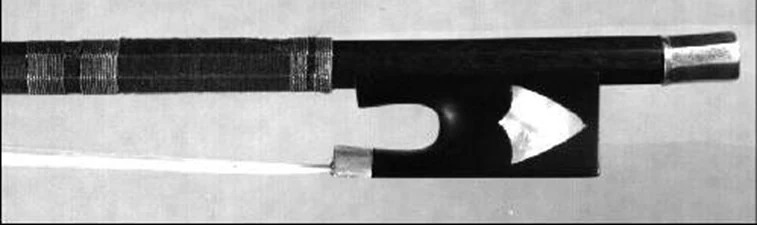
|
This bow is an early work by F. X. Tourte. Its head already displays all the features of a modern bow. The frog has a ferrule, and the hair channel is covered by a mother-of-pearl slide. The decorations on both sides of the frog are also mother-of-pearl. Tourte’s sticks are now made exclusively of pernambuco, a material that ideally combines strength and elasticity. It is still used today for most high-quality modern bows. The metal ferrule introduced by Tourte transformed the hair from a sometimes almost round bundle into a flat ribbon 10 mm wide. The frog was not always ebony; it could also be made from precious materials such as ivory or tortoiseshell, sometimes protected against cracks and chips by a metal heel plate. The button, too, had metal fittings. François Tourte worked with a precision that still inspires wonder. Generations of bow makers after him tried—and continue to try—to copy his model. Tourte belonged to a generation of makers who did not always sign their bows at the end of the stick. His great success soon attracted imitators, first in Paris and later in England, Germany, and Russia. |